By Quanta Classes
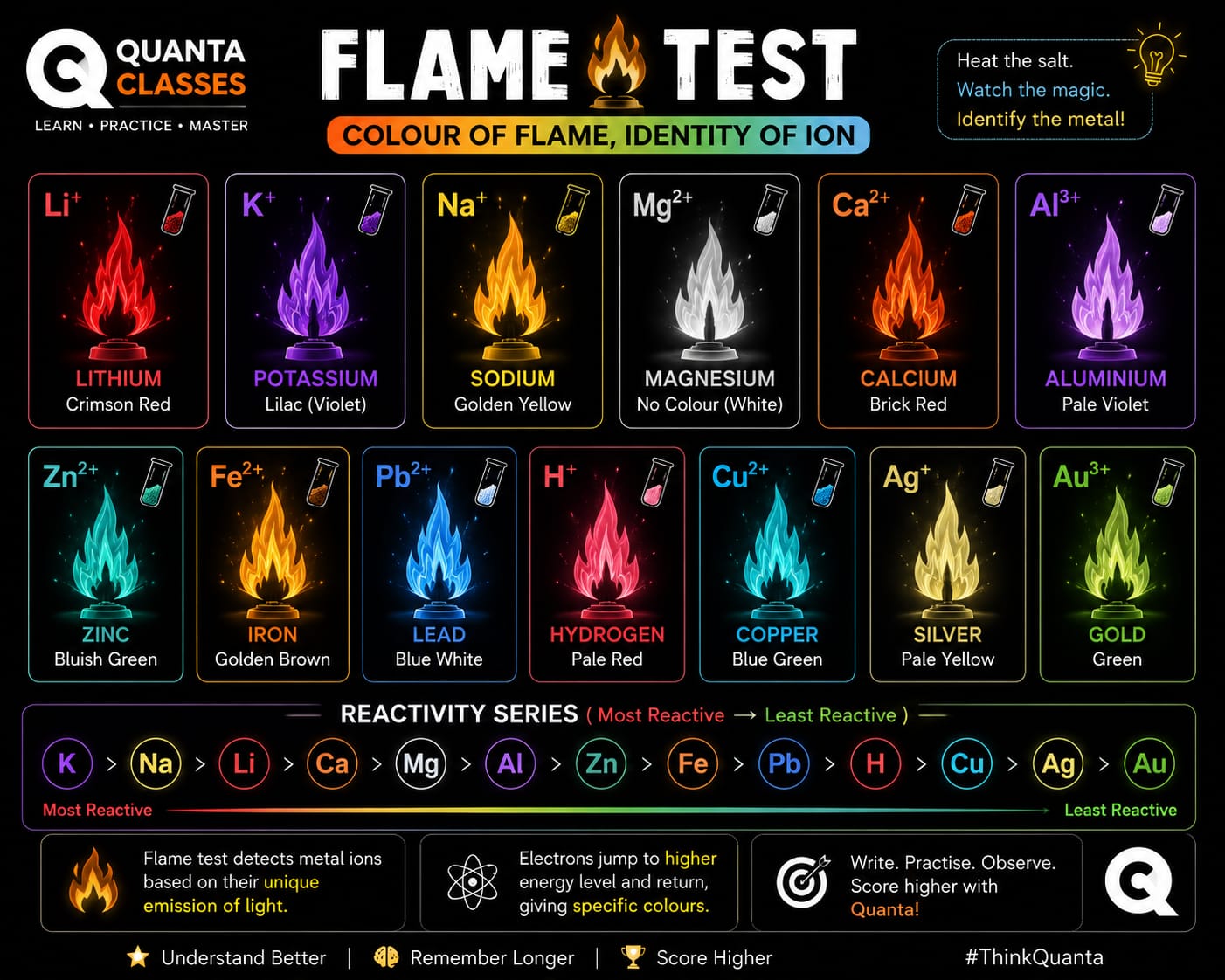
Chemistry becomes truly exciting when reactions create visible changes. One of the most fascinating experiments in Class 10 Science is the Flame Test, where different metals produce different flame colours. This simple experiment helps us identify metal ions and also understand the Reactivity Series of Metals.
In this blog, we will learn:
- What is Flame Test?
- Why different metals produce different colours
- Colours of important metal ions
- Reactivity Series explained
- Real-life applications
- Important exam questions
What is Flame Test?
The Flame Test is a laboratory technique used to identify certain metal ions based on the colour they produce when heated in a flame.
When a metal salt is heated:
- Electrons absorb energy.
- Electrons jump to a higher energy level.
- When they return back, they release energy in the form of light.
- Different metals release different colours.
That is why each metal gives a unique flame colour.
Science Behind Flame Colours
Electrons inside atoms normally stay in fixed energy levels.
When heat is supplied:
- Electrons become excited.
- They move to higher energy levels.
- After a short time, they return to their original level.
- During this return, energy is emitted as coloured light.
Different metals have different electronic structures, so the emitted colours are different.
Flame Colours of Important Metals
1. Lithium (Li⁺)
Flame Colour: Crimson Red
Easily identified due to deep red appearance.
2. Potassium (K⁺)
Flame Colour: Lilac / Violet
Appears pale violet in flame.
3. Sodium (Na⁺)
Flame Colour: Golden Yellow
Very bright and intense. Most common flame test observation.
4. Magnesium (Mg²⁺)
Flame Colour: White / No Distinct Colour
Produces bright white light.
5. Calcium (Ca²⁺)
Flame Colour: Brick Red
Shows orange-red appearance.
6. Aluminium (Al³⁺)
Flame Colour: Pale Violet
Usually gives a weak flame colour.
7. Zinc (Zn²⁺)
Flame Colour: Bluish Green
8. Iron (Fe²⁺)
Flame Colour: Golden Brown Sparks
9. Lead (Pb²⁺)
Flame Colour: Blue White
10. Hydrogen (H⁺)
Flame Colour: Pale Red
11. Copper (Cu²⁺)
Flame Colour: Blue Green
One of the most beautiful flame colours.
12. Silver (Ag⁺)
Flame Colour: Pale Yellow
13. Gold (Au³⁺)
Flame Colour: Green
Reactivity Series of Metals
The Reactivity Series is the arrangement of metals from most reactive to least reactive.
K > Na > Li > Ca > Mg > Al > Zn > Fe > Pb > H > Cu > Ag > Au
This means:
- Potassium is highly reactive.
- Gold is least reactive.
Easy Trick to Remember Reactivity Series
“Kab Na Li Ca Mg Al, Zinc Fe Pb H Cu Ag Au”
You can create your own memory trick for faster revision.
Why is Reactivity Important?
The reactivity series helps us understand:
- Which metal reacts faster
- Which metal can displace another metal
- Which metals react with acids
- Which metals corrode easily
- Extraction methods of metals
Metals Above Hydrogen
Metals above hydrogen react with dilute acids and release hydrogen gas.
Examples
- Potassium
- Sodium
- Calcium
- Magnesium
- Zinc
- Iron
Metals Below Hydrogen
These metals generally do not react with dilute acids.
Examples
- Copper
- Silver
- Gold
Real-Life Applications of Flame Test
Fireworks Industry
Different metal salts are used to create colourful fireworks.
- Sodium → Yellow
- Copper → Blue-green
- Potassium → Violet
Laboratory Identification
Chemists identify unknown metal ions using flame tests.
Astronomy
Scientists study star composition using emission colours.
Industrial Testing
Flame test is used in chemical and mineral analysis.
Important Viva Questions
Q1. Why does sodium give yellow flame?
Because excited sodium electrons emit yellow light when returning to lower energy levels.
Q2. Which metal gives blue-green flame?
Copper.
Q3. Which metal is most reactive?
Potassium.
Q4. Which metal is least reactive?
Gold.
Q5. Why do different metals give different colours?
Due to different electronic configurations.
NCERT Important Points
- Flame test helps identify metal ions.
- Different metals emit characteristic colours.
- Reactivity series is arranged from most reactive to least reactive.
- Metals above hydrogen displace hydrogen from acids.
Conclusion
The Flame Test is one of the most visually interesting experiments in chemistry. It not only helps identify metals through beautiful flame colours but also connects deeply with atomic structure and electron transitions.
Understanding the Reactivity Series further helps students predict chemical behaviour, displacement reactions, corrosion, and extraction methods.
If you master these concepts, Class 10 Chemistry becomes much easier and more scoring.
Quanta Classes
Learn • Practice • Master
- ✨ Understand Better
- 🧠 Remember Longer
- 🏆 Score Higher
Website: Quanta Classes
Related: Best Class 10 Coaching · RBSE & CBSE Tuition · Best Coaching Classes Near Ganganagar